

Settlement, not screenshots: how a tokenized share moves
A buy on Bloom touches four systems before you own anything. Here is each hop, what can fail, and why on-chain settlement changes the guarantees you get.
Key takeaways
- A tokenized share is a claim on a real share held at a regulated broker-dealer, not a synthetic price feed.
- Buying touches four systems: your wallet, an RFQ quote, the issuer's mint, and settlement back to your wallet.
- On-chain settlement means the receipt is the asset, so you can verify your position without trusting a dashboard.
- The trade-off is that redemption follows market hours even though the token moves 24/7.
Most explanations of tokenized equities stop at the marketing layer: a screenshot of a ticker, a claim that it is "backed 1:1", and a link to a reserves page. That tells you nothing about what happens between tapping buy and owning something.
This post walks the whole path. Four systems are involved, each with a different failure mode, and the interesting part is which guarantees survive at each hop.
#The four hops
A single buy is not one transaction. It is a chain of four, and only the last one is visible in your wallet.
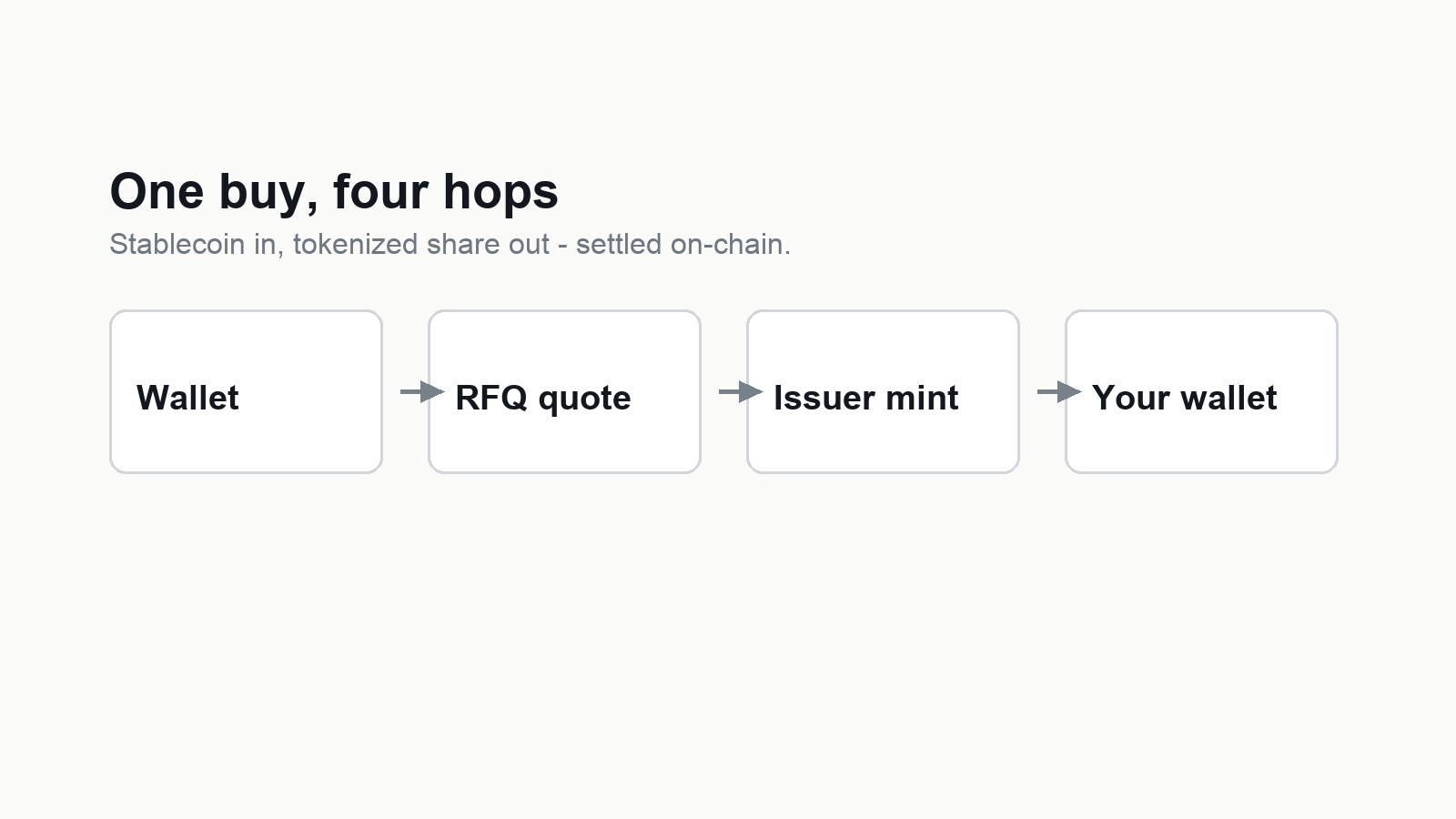
The hops are:
- Your wallet signs an intent and a stablecoin balance is committed.
- An RFQ quote is requested from regulated tokenized-security issuers, who price against real custody.
- The issuer mints against a share it already holds, or sources one first.
- Settlement delivers the token to your self-custodied wallet.
#Where the guarantees actually come from
The phrase doing the work is "already holds". An issuer that mints against a share sitting in segregated custody at a regulated broker-dealer is making a very different promise from one minting against a hedged position.
The receipt is the asset. If the token is in your wallet, the claim is yours, and no dashboard has to agree with you for that to be true.
That is the real shift. In a traditional brokerage, your position is a row in someone's database, and your access to it depends on that database staying available and honest. On-chain, the position is a bearer instrument you hold.
What can still fail
Being honest about this matters more than the pitch:
- Custody risk does not disappear. It moves to the broker-dealer and the issuer. It is regulated and attested, but it is still counterparty risk.
- Redemption is not 24/7. The token moves whenever you want; unwinding to the underlying share follows US market hours.
- Liquidity is not uniform. Spreads widen outside regular hours, and thin names widen more.
#Why this is worth the complexity
You get an asset that settles in minutes instead of days, is divisible to six decimals, moves at 3am, and composes with the rest of an on-chain portfolio, without a US brokerage account or a local broker in between.
The cost is a longer chain of systems than "press buy in an app". The benefit is that the end state is a thing you hold rather than a thing you are owed.
If you want the mechanics in more depth, the docs cover custody, the RFQ path, and reserve attestation end to end, and pricing has the fee schedule that applies at each hop.
Frequently asked questions
Is a tokenized share the same as owning the stock?
You own a token backed 1:1 by a real share held in segregated custody at a regulated US broker-dealer. You get price exposure and corporate actions, but you are not on the issuer's shareholder register directly.
What happens if Bloom disappears?
The backing shares sit at the broker-dealer, not with Bloom, and the tokens stay in your own wallet. Reserve attestations are published so the backing is verifiable independently.
Why does selling sometimes queue?
Mints settle in the same transaction because the issuer can price instantly against custody. Redemptions net against the underlying share, which follows US market hours.